














It wasn’t planned that way, but the Housing Authority of the Town of Winchester began its formation in mid August of 1955. A little rain became a torrent of rainstorms, and soon they became the flood that many Winsted residents remember so well. What was Winsted’s Main Street, home for more than 1,000 inhabitants, became an uninhabitable tangle of wrecked buildings. Many residents knew for the first time what “homeless” meant.
In stepped Winsted’s planners, forming The Housing Authority of the Town of Winchester. On April 30, 1956 Winsted’s Board of Selectmen appointed Mr. Francis D. Campbell, W. Vernon Davey, Edward Hawley, John Nigri and William F. Ramsay, to serve as the first Commissioners of its new Housing Authority. If ever a community needed help with its housing, it was Winsted, in the midst of a horrible state of homelessness for many of its citizens.
First there were tents and then came the temporary trailers. These temporary homes came to be placed on Florence Street as construction took place throughout the hillside between Holabird and East Mountain Avenue.
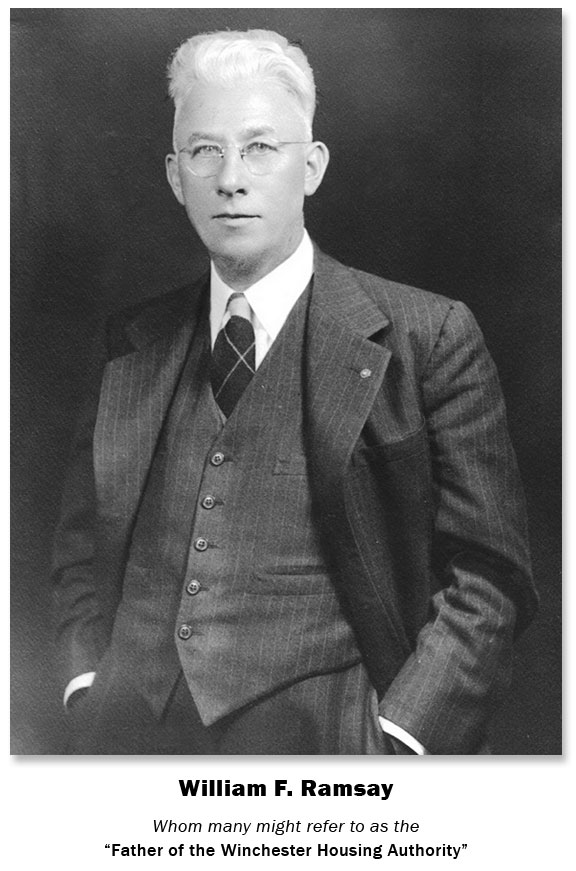 Quickly chosen as its first Chairman was William F. Ramsay. Bill was well liked, and anyone who knew him would say that his sense of humor, quick wit, and generous attitude brought him to this office. As owner of Winsted’s largest furniture store, most all of Winsted’s inhabitants knew him well. Lending his name to this new organization was just what it needed. It had to move quickly and Mr. Ramsay was a Town-wide recognized name. Even today, many seniors remember him well. In asking one time Greenwoods Garden resident Sophie Silverio whose husband worked for Bill, why Winsted named its soon-to-be, first-ever housing development after Mr. Ramsay, she thought for a moment and replied “he was a good, honest man, good to his workers”. She added, “He was a handsome man too.” Also, inquiring of another one time resident, Mr. George Attella, who also lived at Greenwoods Garden, he relates how Mr. Ramsay once visited his outfit and many of Winsted’s servicemen at Camp Blanding, in Florida during WW II. Mr. Attella has proudly hung a photo of one of those visits on his living room wall. He continued saying, “Bill Ramsay was one of Winsted’s greatest guys.” He also added that Mr. Ramsay made a habit of inviting many returning servicemen out for dinner, just to say thanks to them.
As a side note, it is interesting to note, that one of the Authority’s earliest secretary’s, Mrs. Margaret Serafini, recently deceased, was paid the grand sum of $1.75 per hour.
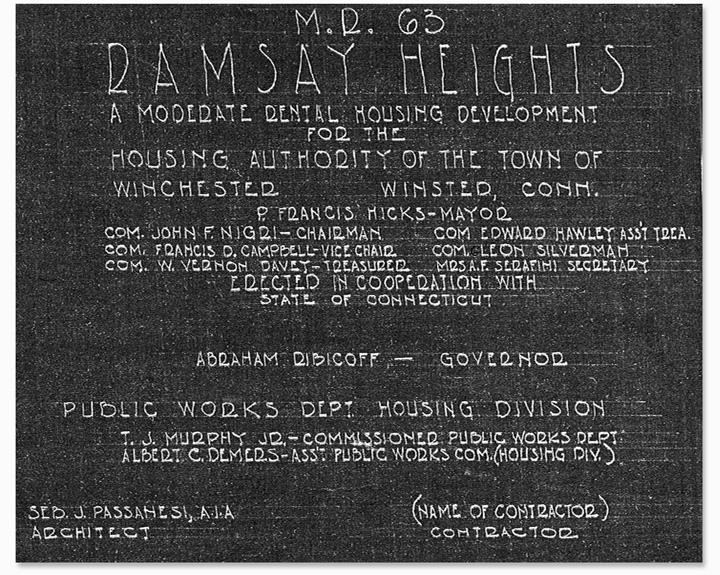 It didn’t take long for Mr. Ramsay and the Board of Commissioners to get the wheels turning. However, not long into these early efforts Mr. Ramsey suddenly died. What followed were meetings whereby is was discussed and voted upon that it was appropriate that the upcoming, first-ever “moderate income” housing development be named in Mr. Ramsay’s honor.
Construction took place over the next two years of 38 duplex houses on new streets, between Holabird and East Mountain Avenue. As this took place residents living in temporary trailer-like homes on Florence Street were gradually relocated into these rental homes. Removal of the temporary trailers from Florence Street followed.
Fifty years later, it is recognized that Winsted's first efforts in “Affordable Housing” were (is) one of the most successful in the State of Connecticut. All of its duplex homes were eventually sold to private homeowners in the late ‘60s. We find that some two family homes have been converted into single-family homes, while others remain two family style. How ironic it is that today’s Winchester Housing Authority, fifty years later, finds itself once again on Florence Street where long ago it placed its disaster relief trailers. Read more on these plans below…
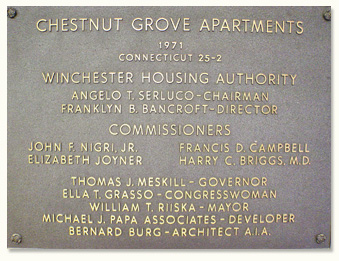 By 1968 the Housing Authority was ready to sell the duplex homes of Ramsey Heights to families currently residing there. Over the next two years, while this took place, plans were being formulated for new Federal Housing on Chestnut Street. It took the name Chestnut Grove, the “Grove” coming from fruit trees planted there by the Franciscan Friars of St. Joseph’s church. In 1970 plans were approved and construction of this 80 apartment building was started. With no time to rest, almost immediately following the completion of Chestnut Grove, plans were starting to be reviewed for a forty-unit apartment complex to be known as Greenwoods Garden. The construction soon followed with its opening in 1972.
 In 1975 rental assistance continuedto be found necessary for Winsted. The Authority’s Executive Director sought to establish a Federal Program known as Section 8 Rental Assistance. HUD provided the first fifty vouchers for the Housing Authority in November of 1975.
In 2002, with waiting lists for its Greenwoods Garden and Chestnut Grove facilities reaching nearly one hundred, The Authority once again began planning for additional Senior Housing. This time the site focused on an area on Gay Street adjacent to Winsted’s downtown. The site chosen contained an unattractive warehouse and garbage truck transfer station. Soon plans were formulated for Winsted’s new Laurel Commons, now run by the Winchester Housing Development Corporation (WHDC). Its first resident located there in February of 2005, with forty-three others soon after.
During the construction of Laurel Commons the Winchester Housing Authority applied for and receives tax-exempt status as a non-profit corporation. The new Winchester Housing Development Corporation soon began to receive tax credit grants, providing dollars for much of the costs of Laurel Commons. Having a non-profit under its wing, the Authority sought to set out a FIVE-YEAR STRATEGIC PLAN (2004- 2009). Several local banks, foundations and companies donated towards the costs to develop this PLAN. Not long after completion of the PLAN, the Authority received unanimous support from both the Towns Economic Development Commission and Revitalization Commission. The focus of this new PLAN is to once again provide affordable homes for the citizens of Winsted. This PLAN has been updated (2009 – 2014), following much of the initial PLAN. You may read the FIVE-YEAR STRATEGIC PLAN (2009 - 2014) (in PDF format) by clicking here. However, with a renewed warning from many Public and Private Agencies, of the tsunami of seniors about to converge on our society, a greater emphasis has been placed on senior housing and associated services. To that end, the WHA and the WHADC prepared an Awareness Report for the Board of Selectmen and all Town agencies. You may read the Awareness Report (in PDF format) by clicking here.
Quite interestingly, headlining the PLAN is the return to Florence Street once again, (fifty years later), for the construction of fourteen new, affordable, single-family homes. Although it is not the disaster of 1955, The Housing Authority of the Town of Winchester sees both a looming housing shortage and an opportunity to again provide help for its community in planning for these new homes. It is intended that a preference be given to the Town’s volunteer firemen and ambulance technicians who are income qualified. It is found that many new, younger volunteers cannot afford to live in the Town they sometimes risk their lives for. Housing costs, primarily due to skyrocketing land costs, has made the cost to purchase a new home out of reach for many of these volunteers, and many other Winsted residents. We can feel sure that Mr. Ramsay and the countless number of Commissioners that have followed would look favorably upon today’s Winchester Housing Authority and its return to Florence Street atop the hill of Streets once called Ramsay Heights.
Conclusion...Or, New Beginning?
We hope that the 100th Year Celebration of the
Housing Authority of the Town of Winchester
may some day say that in its second fifty years,
it continued to contribute to the success of its
town, equally as it did in its first fifty years.
Our hats are off to those taking part in
the future of our Town's
Housing Authority
 All rights reserved ~ Copyright © 2011-2021